
The Creative Health Cartography Workbook Virtual Book Tour
from Kathryn Vercillo

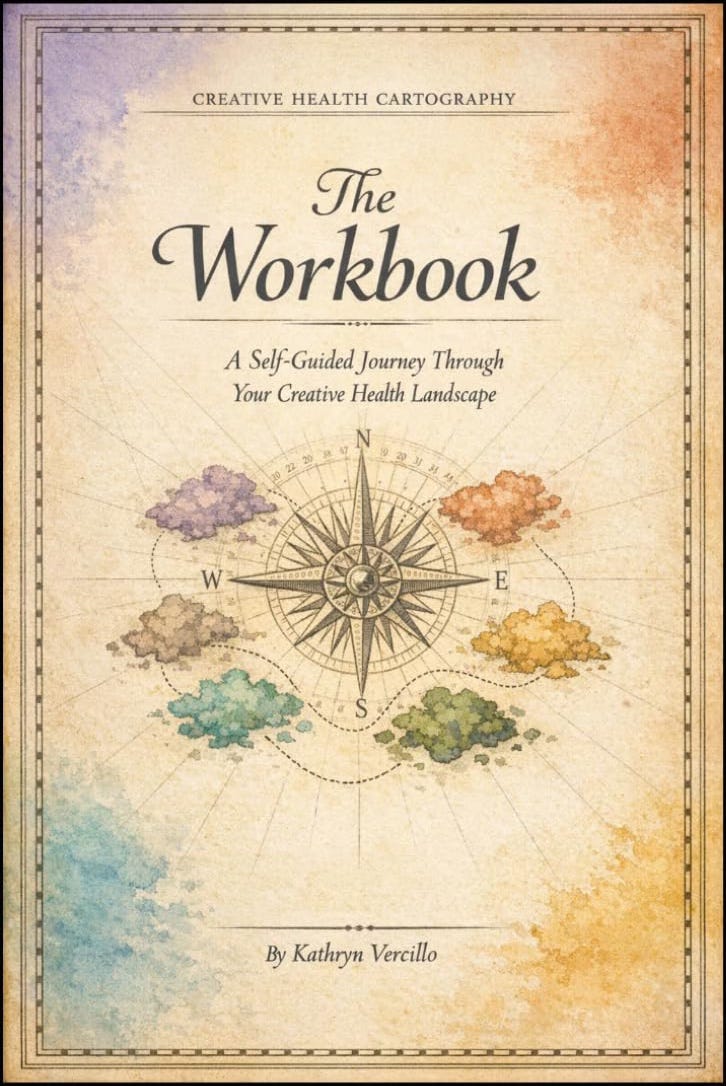
A few weeks ago, I got an email from Kathryn Vercillo, inviting me to participate in a virtual book tour for her new work, the Creative Health Cartography Workbook. I came into contact with Kathryn when I subscribed to her Substack as part of my prep for launching Creativity 4 Life. All my research suggested that it was important to sign up to other creators’ Substacks, post likes and comments, and generally engage with the ecosphere. So, I did what I was told (highly unusual for me), searched for things with ‘create’ and ‘creativity’ in the title, and subscribed to just four Substacks.
Kathryn’s Create Me Free was one of those four. I thought that engaging with the Substack world would be something I did out of necessity, but I quickly found that Kathryn’s writing struck a real chord in so many different ways. She got me thinking about things in a different way, and challenged ideas I have been taking for granted. As a result, engaging has never been a chore. Instead, it is a source of pleasure, ideas, and different perspectives.
I am therefore delighted to be able to host one of Kathryn’s essays. I hope you enjoy it as much as I did. And I wish Kathryn success with the remainder of her book tour.
What Psychology Actually Says About Creative Blocks
by Kathryn Vercillo of Create Me Free
A tour through the research, with some skepticism about what the self-help industry has done with it
The self-help industry has a great deal to say about creative blocks. Most of it is loosely connected to actual psychology research. Some of it is connected to nothing except hype and confident delivery. And some of the most widely repeated advice (the morning pages, the habit stacking, the identity-based behavior change frameworks) contain real insight that has been packaged in ways that strip out the nuance and present a simplified version as universal prescription.
Here is what the research actually shows, and where the popular conversation tends to go sideways.
Anxiety and avoidance
Anxiety produces avoidance. When creative work carries a sense of threat, the nervous system responds by making the work feel dangerous to approach. The person who wants to write and finds themselves doing everything else, who cleans the kitchen and checks messages and reorganizes their desk and does not sit down to write, is experiencing something specific: the nervous system has coded the act of sitting down to write as threatening, and it is doing what nervous systems do when threatened, which is steer away from the source of danger.
Approach-avoidance conflict is the psychological term for being drawn toward something and simultaneously pushed away from it. Creative work, particularly for people who care about it deeply and have significant identity invested in it, frequently operates this way. The importance of the work is precisely what makes it threatening. The more it matters, the more the nervous system stands guard at the entrance.
What the research supports as genuinely helpful here is graduated exposure: small, low-stakes engagements with the work that reduce the threat response over time rather than trying to overpower it. The five-minute practice. The private sketchbook that no one sees. The shitty first draft that exists only to be revised beyond recognition. These recommendations have real research behind them, and they work by the same mechanism as other exposure-based approaches to anxiety: repeated, manageable contact with the feared thing until the threat response habituates.
The practical implication is significant. Pushing harder into creative avoidance, demanding more willpower and discipline, tends to intensify the approach-avoidance dynamic rather than dissolve it. Reducing the apparent stakes of the initial engagement, making the first step genuinely small, is more effective precisely because it is less impressive.
Self-efficacy and creative output
Albert Bandura’s research on self-efficacy, developed over decades at Stanford, is among the most replicated findings in psychology: belief in your own capacity to do a specific thing is one of the strongest predictors of whether you do it. Applied to creative work, creative self-efficacy predicts creative output in ways that hold up across studies, contexts, and creative domains.
People who believe they can make things make more things. People who carry internalized stories that code them as insufficiently talented, sufficiently serious, or sufficiently legitimate as creative people, produce less, attempt less, and abandon work at earlier stages.
This is one of the most practically important findings in the research for the Creative Health Cartography framework, because it suggests that the narrative work of examining the stories you tell about yourself as a creative person has functional consequences rather than being purely psychological. The story you carry about who you are as a maker directly affects what you make. The narrative domain is connected to your actual creative output through mechanisms that Bandura’s research makes legible.
What the research is more tentative about
The research on productivity techniques and habit systems is surprisingly inconclusive despite the prevalence of articles across the Internet. Specific techniques like time-blocking, habit stacking, and identity-based behavior change do have real theoretical grounding and do produce results for some people in some contexts. The evidence that they produce sustained creative output for most people across varied life circumstances is considerably weaker than the confidence with which they tend to be promoted. That doesn’t mean we shouldn’t experiment with them. They are tools and tools can be useful. But they are not solutions, per se, and the gap between a useful tool and a universal answer is wide.
The research is also relatively clear that creative blocks have multiple causes that interact in complex ways, and that psychological interventions alone address only part of the picture. Physical health, chronic illness, neurological factors, the genuine demands of a life with limited time and energy, the structural and financial conditions of a creative practice: all of these contribute to creative difficulty in ways that mindset work and behavioral techniques address partially at best.
The multivariate reality of creative health is one of the reasons the workbook examines six distinct domains rather than offering a single explanatory framework. No single mechanism, anxiety, self-efficacy, executive function, relational support, financial stability, fully accounts for the complexity of what makes creative work accessible or inaccessible for any given person in any given period of their life.
What twenty years of research has actually taught me
After two decades of reading this research alongside conducting my own interviews, alongside completing graduate study in psychology, alongside using the framework with real people in real creative situations, and most importantly through my own lived experience, what I have learned is to hold the research as orientation rather than prescription.
The research tells you about patterns across populations. It identifies mechanisms that tend to operate in recognizable ways across many people. It gives you a vocabulary for what might be happening when creative work becomes difficult. That vocabulary is genuinely useful. It helps you ask better questions about your own situation.
What the research cannot do is tell you which pattern is yours. Your creative health situation is specific to your body, your history, your nervous system, your life circumstances, the particular intersection of domains that makes your situation unique. Population-level patterns are starting places for inquiry, and inquiry is what the workbook is designed to support.
You already carry a great deal of knowledge about your own creative life. The research gives you language for it. The Creative Health Cartography workbook gives you a structure for examining it.
What you find when you look is yours, specific and irreducible to anyone else’s pattern, and that specificity, I hope, is exactly what makes it useful.
**************************************************************************************
This was a guest post from Kathryn Vercillo as part of her Creative Health Cartography Workbook tour. Follow the full tour at createmefree.substack.com.
If you liked this essay, then you might also like to read: https://createmefree.substack.com/p/what-to-do-when-you-feel-creatively
You can use the WorkbookTour20 promotion code if you wish to purchase workbooks or her Creative Health Maps and Creative Health Navigation resources. A PDF of her Creative Health Cartography Workbook is available at https://tinyurl.com/CHCworkbook
You can also find her new podcast at createmefree.substack.com
And there is a free Creative Health Archetype quiz at http://tinyurl.com/createmefreequiz
Thanks for reading, and I’ll see you Monday for some meanderings on all the things that go to make up our (creative) identity. (That sounds about as interesting as a week-old newspaper. However, trust me, we have lots of good stuff in store.)
Till the next time, be bold!
Alisdair.