
FEAR OF FAILURE
Getting out of my (creative) comfort zone

Change of plan! The components of identity can wait till next week.
In an afterthought to my last post on the creative personality, I alluded to the idea that we all have a (creative) comfort zone, in other words, the part of our comfort zone that relates to creativity. Just in case you missed it, this is what I said...
There is a strong correlation between our (creative) personality and our (creative) comfort zone, because personality guides behaviour.
The idea of many creative attributes, each on a continuum with a ‘positive’ at one end and a ‘negative’ at the other and differing degrees of comfort operating between extremes, suggests that we each have a unique profile, a comfort zone within which we are confident and relaxed about being creative.
There is no one right way to be creative. Indeed, this perspective suggests that there is an almost infinite number of ways of being creative.
And whenever we have an opportunity (or are forced) to work outside our comfort zone, growth follows, and our comfort zone extends.
Well, this week, I was challenged to get out of my own (creative) comfort zone. One aspect of my own creative identity is that I consider painting to be an important part of who I am. I draw, in pencil and pen & ink, and I paint in watercolour. In my late teens, I discovered the Golden Age of children’s book illustration: Arthur Rackham, Edmund Dulac, W Heath Robinson and his brother Charles, Jessie M King, Mabel Lucie Atwell, Kay Nielsen, Edward Detmold, Harry Clarke, and the rest. If I could draw people and animals, I might have been an illustrator. Alas...
With inspiration from American architect, Arthur C Guptill, and contemporary illustrators like Roger Dean and Peter Weevers, I was fortunate enough to discover (or develop?) my own style fairly early on. I love detail, I love stones, and I love the things that involve stones in their construction, especially buildings in a state of some dilapidation. The land and seascapes of the Outer Hebrides, where I now live, provide countless opportunities for me to indulge myself. Everything, everywhere, is a picture waiting to be captured. I found my niche and stuck to it. When people come into our gallery on the Isle of Lewis and chat with my wife, Les, snippets of their conversations drift upstairs to where I am beavering away on one project or another. A frequent comment is something along the lines of, “Gosh, he likes his stones, doesn’t he?”
So, it was with more than a little trepidation that I accepted a commission to do a watercolour of the Tobermoray Lighthouse on the Isle of Mull, in Scotland’s Inner Hebrides, about 100 miles south of us. You see, stones are just like creativity: there is no one right way to do them. They come in all shapes, sizes, and hues. Geology, climate, glaciation, and a hundred and one other factors make sure of that. So, it is pretty near impossible to get a stone ‘wrong.’ I love trees and skies and seas and lichens for exactly the same reason.
Now, a lighthouse is a very different proposition. It’s got lines that need to be pretty straight, and curves that require just the right radius. The light has to fall in a consistent way across its various surfaces. It’s an actual place, so liberties with representation are off the table (apart from the minor latitude permitted by artistic licence – I omitted some solar panels from my rendition).
Time to own up about one of my other ‘gifts.’ I am a reformed perfectionist! I say ‘reformed’ because I am no longer quite as particular as I was in my 20s, 30s, and 40s. Indeed, I nowadays rejoice in many forms of imperfection. I love the quirky characters in a movie. I can walk past a picture that has been hung slightly askew. I can overlook the slightly bent corner on a book delivered by the Royal Mail. So, I’m very proud to confirm that I have mellowed with age, well, mellowed a little perhaps. However, when it comes to drawing something like a lighthouse, I’m back to being that rigid, unyielding perfectionist that used to get on everyone’s nerves. So, there were only two ways that the lighthouse was going to go: right or wrong!
You might recognise my response. I procrastinated. I had managed expectations with my patron. I explained that I had to complete the year-end financials for our gallery. And I had to get the gallery ready for the new season, which meant making the opening stock of handmade journals, greetings cards, and my funky felt pebbles. And my patron was just brilliant. No pressure, Alisdair. In your own time, Alisdair. Make sure you enjoy the process, Alisdair. You couldn’t ask for a better customer.
So I gave myself quite a bit of wriggle room.
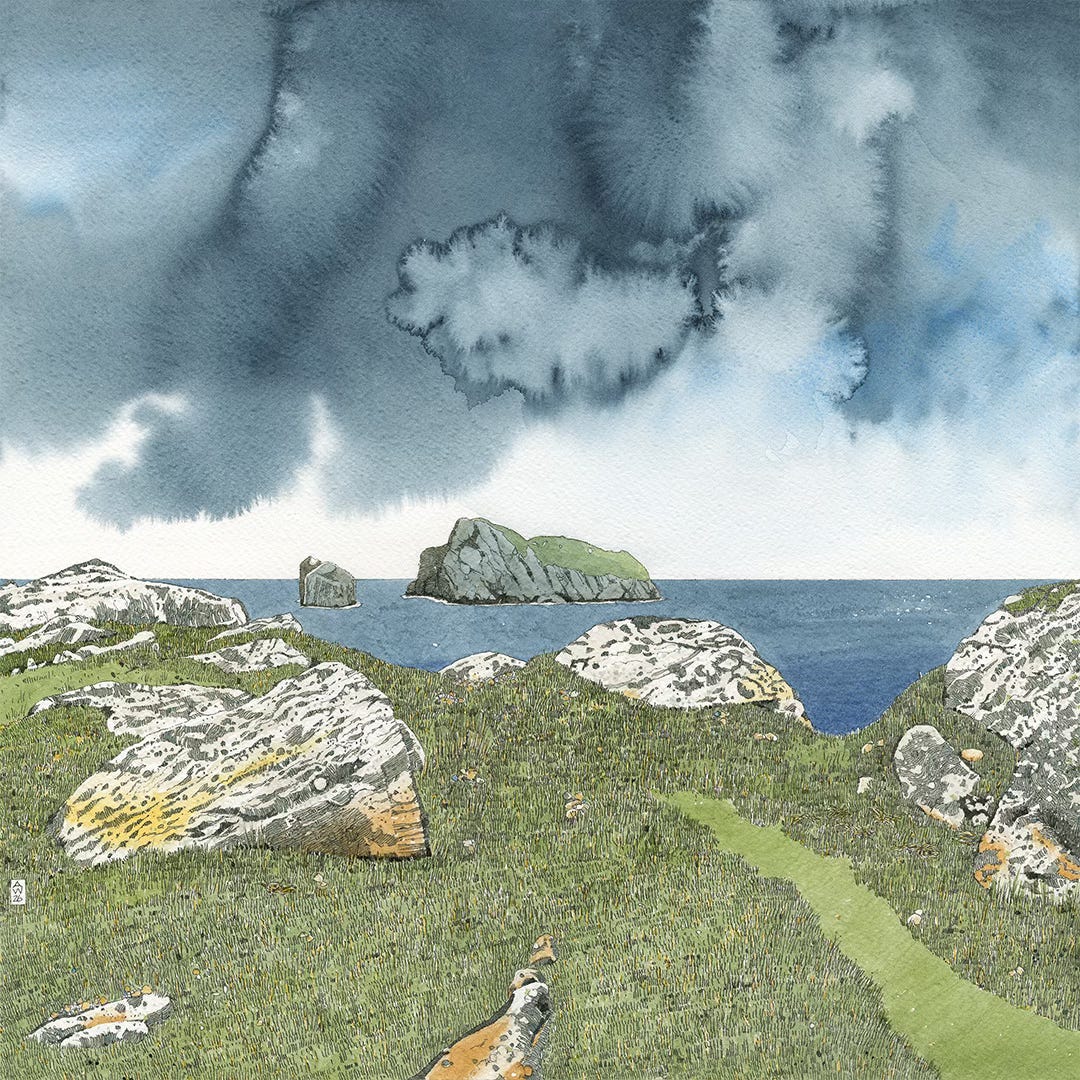
I had two watercolours to do for this commission. The first was right up my street: the island of Boreray from The Gap, on St Kilda, a small group of islands 50 miles out into the Atlantic and one of only 41 UNESCO Dual World Heritage sites on the planet. So, think stubby grass, bleached rocks, seas, islands, and big, big skies. As soon as my start-of-the-season chores were out of the way, I tore into the first watercolour, completing the drawing and painting in no time at all. (It’s the one at the top of this post.)
That’s when procrastination kicked in. The lighthouse, eugh, the lighthouse. I found myself doing the other horrible jobs that I had been putting off, like reorganising cupboards, filling out forms, and cleaning my mountain bike. Jobs I hated, but jobs that held less fear than the lighthouse.
Then I found myself writing that afterthought on creative personality about the idea of creative comfort zones, the combination of circumstances where we feel safe to be creative. I reflected on the idea that growth comes from operating outside our comfort zone. Inside, I felt the merest hint of discomfort. I thought, “I can’t be shouting about the need to get out of our comfort zones when I am clearly resisting myself.”
I threw caution to the wind... No, too melodramatic. I had a reasoned conversation with myself. I thought about the reasons why I might succeed, rather than those associated with failure. I had successfully handled complex architectural subjects before, so I could again. I dumped the false constraint of feeling like I had to get the drawing right the first time. I realised that the lighthouse was less than 10% of a much bigger picture, and I knew I could handle the other 90%. As I reflected, I could feel a lightness that wasn’t there before. I’m not sure ‘lightness’ is the right word, but I know that the lighthouse no longer loomed large. I had put things into proportion. I was ready to go. I got started soon after.
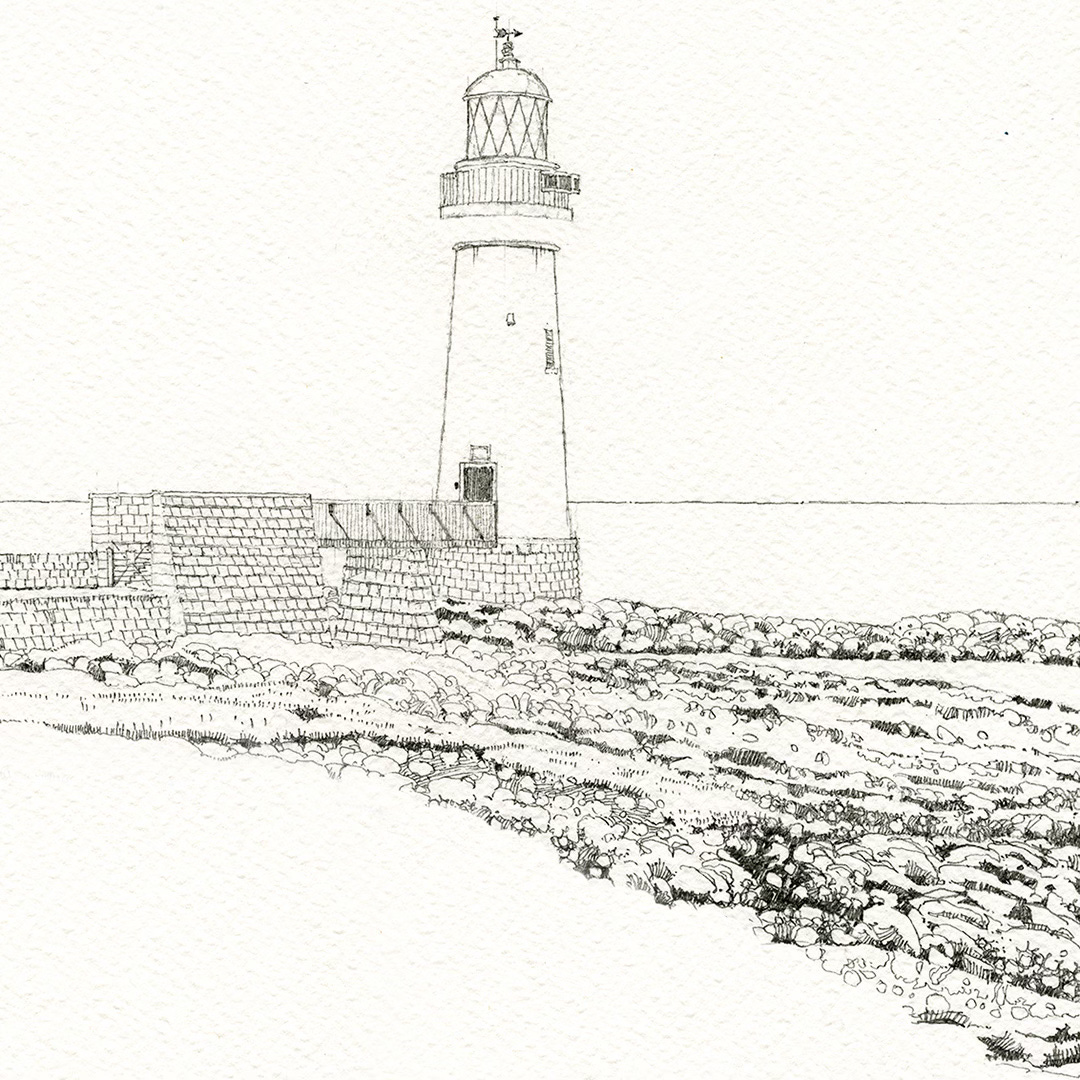
And when I did get started, I went straight for the jugular. The first tentative line was the central vertical around which everything else would be symmetrically organised. I drew the angled sides, which gave me nearly three-quarters of the mass of the structure. I worked back along the walkway that gives access to the lighthouse. I drafted the lantern room that houses the light atop the structure. I sketched the lantern room’s cap and the weather vane. In no time, I had 95% of the lighthouse completed to my satisfaction. That just left the buttressed area below the gallery with all its fancy ins and outs, and curves and shadows. Suddenly, I was back in anxious mode.
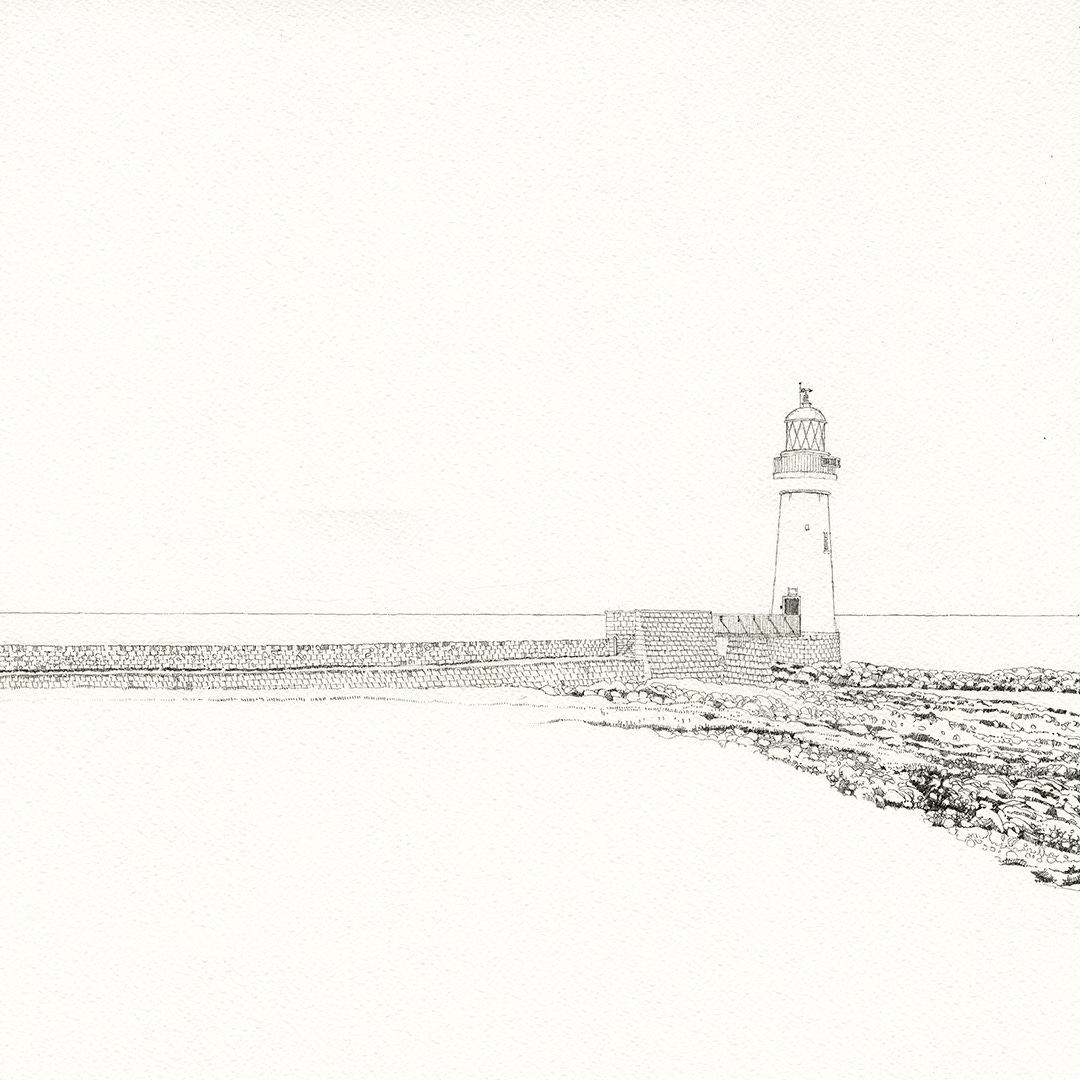
So, I ignored the incomplete lighthouse for a while and jumped back into my creative comfort zone: rocks and grass. Bliss.
The following morning, I woke with a clear picture in my mind’s eye of how to render the area below the lantern room, and it worked first time. Home strait.
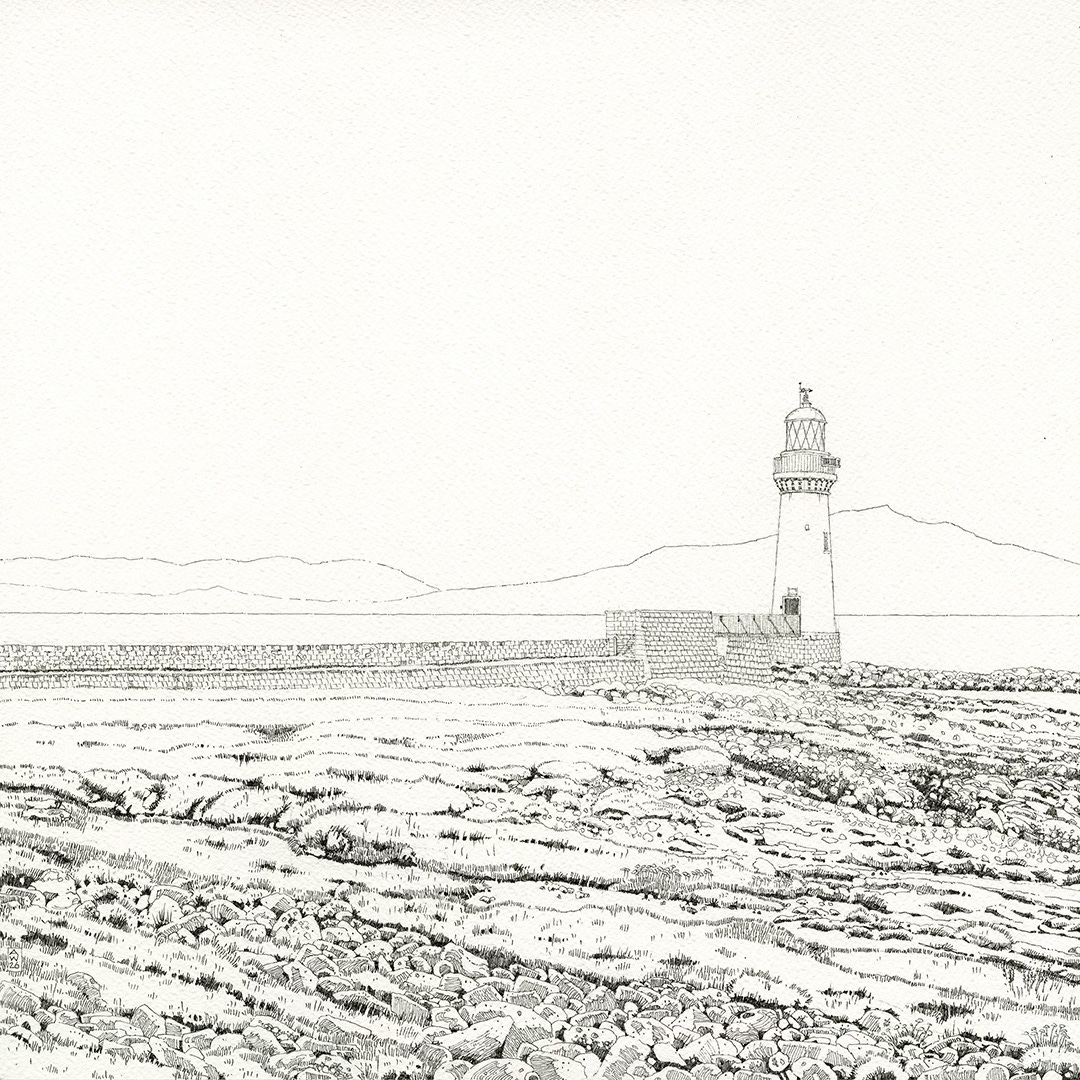
When it came to the watercolour, I adopted the same tactic. I went for the lighthouse first and moved out from there. I'll let you be the judge of the result, but I was happy. In fact, I was delighted. It felt like this might well be one of my best ever watercolours.
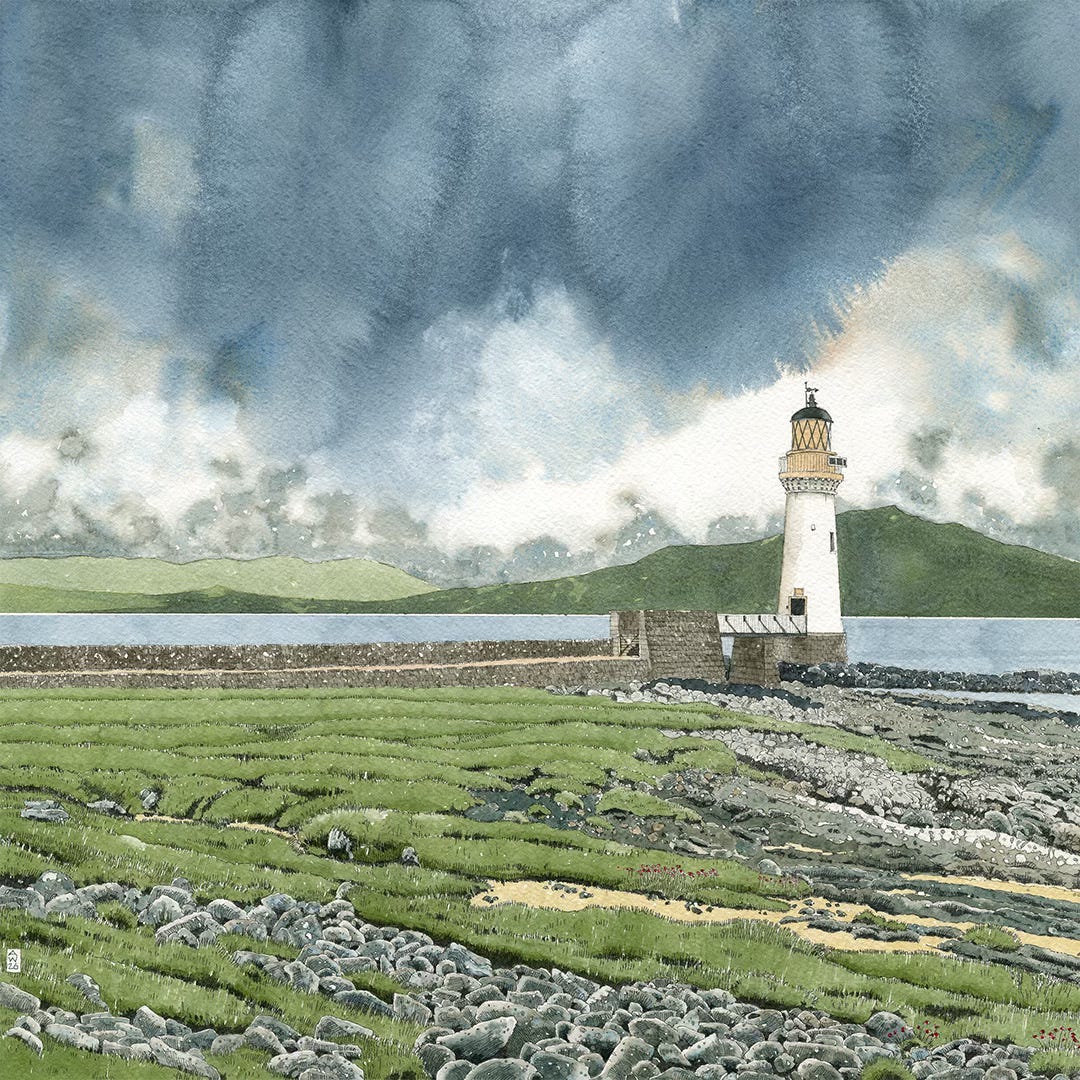
Then there was the anxious moment where I sent a pic of the completed watercolour to my patron.
”I absolutely love it. Thank you very much,” he responded almost immediately.
“Phew!” I replied, and we had a happy email exchange where I confirmed he was now the owner of the largest private collection of my watercolours on the planet.
“I am pleased I have the largest private collection on the planet,” he said. “When we are both in the gallery in the sky, and you are recognised as the next Matisse or Renoir, my heirs will be on the Antiques Roadshow receiving one of those jaw-dropping valuations??!!”
I responded with, “That’s the first time, and I suspect the very last, that I have been mentioned in the same sentence as Matisse and Renoir, but I shall bask in the moment nonetheless! And I love the notion of the gallery in the sky. What a wondrous place that will be.”
The two watercolours are already winging their way through the Royal Mail’s distribution system.
The two watercolours are already winging their way through the Royal Mail’s distribution system.
What have I learnt? (aka key takeaways)
It’s OK to be scared. As long as the fear does not become debilitating, it’s just part of my body’s way of preparing me for something that I know might not be straightforward.
It’s also OK to procrastinate (for a while). Again, this can be my body’s way of saying I’m not ready. (Thanks to Kathryn Vercillo for these alternative and empowering perspectives.)
It’s me that gives fear its wings, so it’s up to me to clip those wings. There are things out there that we should fear if we were ever unlucky enough to encounter them, like the Inland Taipan snake, native to Australia. A single bite holds enough toxin to kill over 100 humans. And then there are fears of our own construction...
It’s reassuring to know that I can sneak outside my (creative) comfort zone without doing any damage. Indeed, it heightened the sense of achievement once I had completed the job. (I don’t think it’s a thing yet, but I would call that creative exhilaration, and it sits on the spectrum that has creative mortification at the opposite end.)
It’s comforting to know just how easy it is to return to the familiar. And, sometimes, this is the right thing to do.
Operating inside our comfort zone, sometimes called ‘playing it safe,’ is increasingly perceived as a failure to achieve our full potential. This is another one of those nonsensical binary choices: if we’re not going for broke, we’re taking the easy road. If we’re not failing here and there, we’re not trying hard enough. Yuk! There are many shades of grey between the two extremes. The wider an individual’s range, the more likely it is that they have a larger comfort zone. However, that doesn’t make an individual with a narrower range a bad person. I once attended a workshop where one of the presenters said, “Some people will show you how to walk over hot coals. I’ll show you how to walk around them.” That thought has stayed with me.
Another presenter at that same workshop said, “Everything in moderation, except moderation.” Put another way, I don’t need to spend my entire time outside my comfort zone. It’s OK to take a breather.
Call to action
Give yourself a break! I mean that in two ways. Literally, there’s no call to action this week. However, if you really must do something, and if you tend to scold yourself for taking the easier option, consciously give yourself a week away from self-reprimand and enjoy your comfort zone.
Next time
Our comfort zone is just one of the many components of our (creative) identity. So, that’s our next stop on the tour: a brief (ha ha, that’ll be the day!) insight into what constitutes identity. Really, though, I’ll keep it short, because each element deserves its day in the sun and a deeper dive. (Apologies for the mixed metaphor – I mentioned previously that I can’t be trusted in that department.)
That’s it for this time round, but remember,
A solid creative identity is all you need to be creative for the rest of your life.
Thanks for reading. And thanks for sticking with me. Remember, my aim is to help liberate the innate creativity that resides in every person on the planet, and I can only do that if I get my ideas to a wider audience. So, please recommend C4L to one person this week.
Till next time, be bold!
Alisdair.
PS I know this post is about a more conventional view of creative expression: painting. Rest assured, however, that I remain committed to the authentic definition of creativity: bringing something into existence (where the something can be absolutely anything, tangible or otherwise.)